Turning a Seasonal Commodity into a Profitable Product
🌎 Overview
Successful campaigns don’t start with ads—they start with identifying the right market opportunity.
During the summer of 2026, the U.S. experienced prolonged periods of extreme heat while millions of people attended FIFA World Cup matches, fan zones, and outdoor watch parties. This created a clear increase in demand for products that helped people stay comfortable outdoors.
Rather than competing in the saturated market for jerseys, flags, and other World Cup merchandise, I identified an opportunity to promote a product that solved a real seasonal problem: Cooling Towels.
The objective wasn’t to create demand—it was to match existing demand with the right product and convert it efficiently through Meta Ads.
🎯 The Challenge
Launching a campaign during the World Cup meant competing in one of the busiest advertising periods of the year.
Higher competition increased auction pressure and advertising costs, making profitable customer acquisition more difficult. Success depended not only on choosing the right product but also on maintaining efficiency while scaling.
The primary goal was to acquire customers at a profitable Cost per Purchase while maintaining a strong ROAS throughout the campaign.
🎨 Creative Strategy
Instead of building the campaign around football itself, I built it around the problem customers were experiencing.
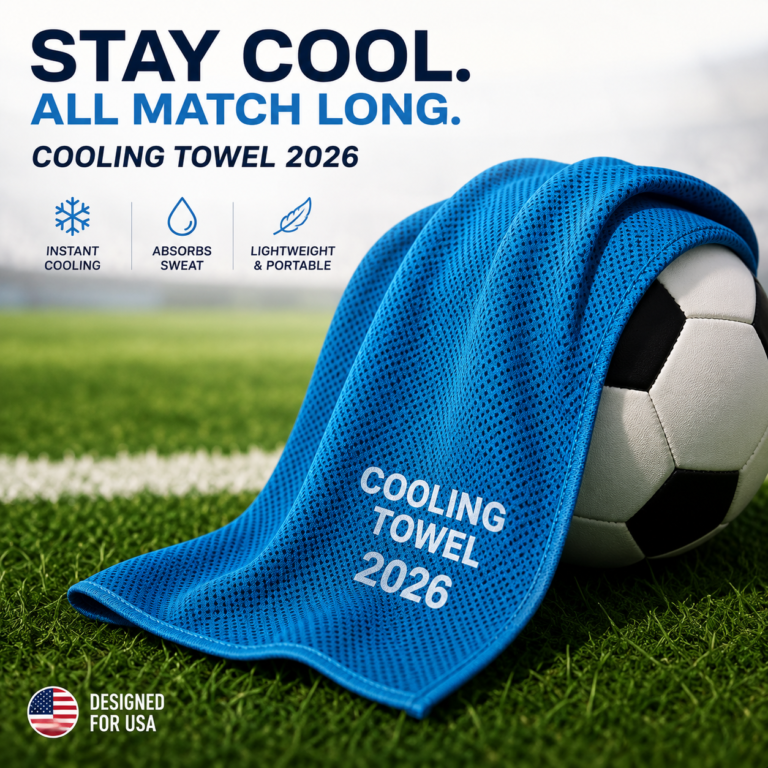
The creative positioned the cooling towel as a practical solution for staying comfortable while watching or playing football during hot summer days. Football provided the context, while the product remained the primary focus.
To maximize performance in the Facebook feed, every creative followed the same principles:
Immediate product visibility
Clear seasonal relevance
Minimal copy
Mobile-first design
Strong visual focus on the product benefit
The objective was to communicate value within the first few seconds and generate high-quality traffic rather than simply maximizing clicks.
⚙️ Campaign Strategy
The campaign was intentionally structured around continuous testing and data-driven optimization.
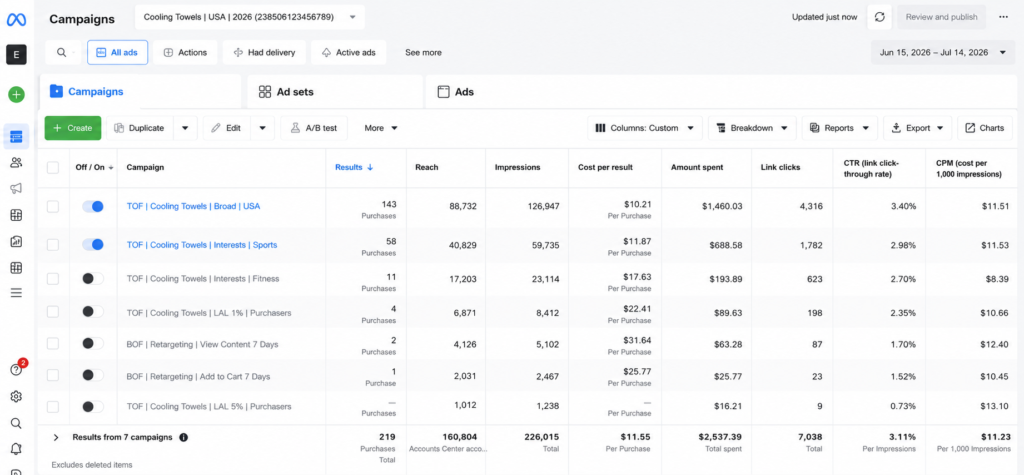
During the testing phase, multiple audience segments and creative variations were launched simultaneously to identify the combinations that generated the most efficient customer acquisition.
Optimization decisions were based on overall business performance rather than a single metric, including:
Cost per Purchase (CPA)
Return on Ad Spend (ROAS)
Click-Through Rate (CTR)
Conversion performance across the funnel
Underperforming ad sets were paused after collecting sufficient data, while budget was gradually shifted toward the strongest-performing combinations.
By the end of the campaign, only two ad sets remained active and generated the majority of purchases.
📊 Results
The campaign generated 287 purchases while spending approximately $2.9K, maintaining profitable customer acquisition despite increased competition during the World Cup period.
Performance Summary
Purchases: 287
Ad Spend: ~$2,900
Cost per Purchase: $10.12
ROAS: 3.94x
CTR: 3.40%
CPC: $0.35
Reach: 168,420
Impressions: 241,893
Add to Cart: 1,127
Initiate Checkout: 612
Rather than relying on a single winning ad, campaign performance improved through structured testing, disciplined optimization, and continuous budget reallocation toward the highest-performing audience and creative combinations.
💡 Key Takeaways
This campaign reinforced one of the core principles of performance marketing:
Strong results come from solving real customer problems—not simply promoting trending products.
Seasonal relevance created the opportunity, but systematic testing, data-driven optimization, and disciplined budget allocation were what turned that opportunity into profitable growth.
For me, successful performance marketing is about identifying the right market opportunity, validating assumptions through experimentation, and scaling only what consistently delivers measurable business results.